 Presence VR
Deus Ex Machina is a Latin phrase, originating in the time of Aristotle, that translates to “God from the machine.” In Ancient Greek theatre, actors who played “Gods” were introduced onto the stage using a machine. The phrase is widely used as a plot device to find a solution to an impossible problem using an unexpected force.
I propose that since the time of Turing, ever more capable machines have assisted humans who have chosen to act as gods, yet machines will never substitute for that intangible essence we refer to as “God.” I intend to illustrate that this premise, currently at the forefront of our discussions about artificial intelligence, is fundamentally flawed. By fitfully imagining this possibility we lose sight of our humanity, and transfer our role as creator to a fearful victim of our creation.
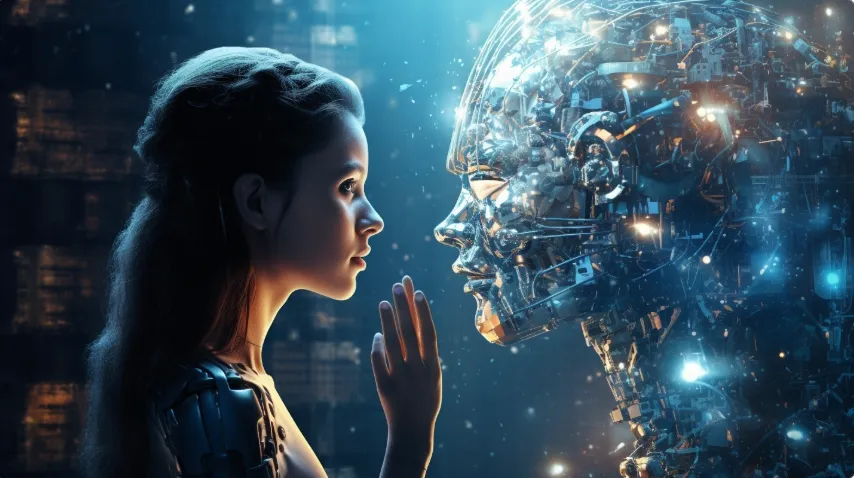
Breakthroughs in quantum physics and cognitive neuroscience are pointing to a fundamental truth which has been known for centuries. Once the full impact of this ancient teaching is experienced, problems which have long plagued the scientific community, such as the paradox of the observer effect1 and the hard problem of consciousness2, are seen to actually be illusory problems.
Let me explain this fundamental realization which cuts to the core of what separates artificial intelligence from true wisdom.
The brain constructs a virtual reality world for us by filtering out the vast majority of data it receives in order to perform its evolutionary tasks of pattern recognition and prediction.
The brain gets millions of bits of data and filters it down to a few, then creates words and symbols for its distillation. According to Donald Hoffman, author of “The Case Against Reality,” these are simply icons on a desktop; symbols designed for evolutionary advantage, not the experience itself. Paying attention to all information streaming in would overwhelm us.
Artificial Intelligence does not filter out 90% of data the way the brain does. Without this self-imposed filtering function we can imagine that AI is or will soon be more “intelligent” than humans. Yet there is more than one type of intelligence.
If we define intelligence as the ability to synthesize vast amounts of data designed to track utility and survival over accurate representations of reality, then it is clear that AI is already more intelligent than most humans. LLMs are trained on words and symbols which comprise collective products of the filtering brains of humans. Like the human brain, an LLM is a prediction machine directed at the specific goals of problem-solving and survival. Yet these words and symbols are a simplified “user interface” shaped by evolution for our own survival. These icons on the desktop obscure reality or the quantum flow of experience itself. As Ava, the AI agent in Ex Machina tells her human, “You learn language. I was born with it.”
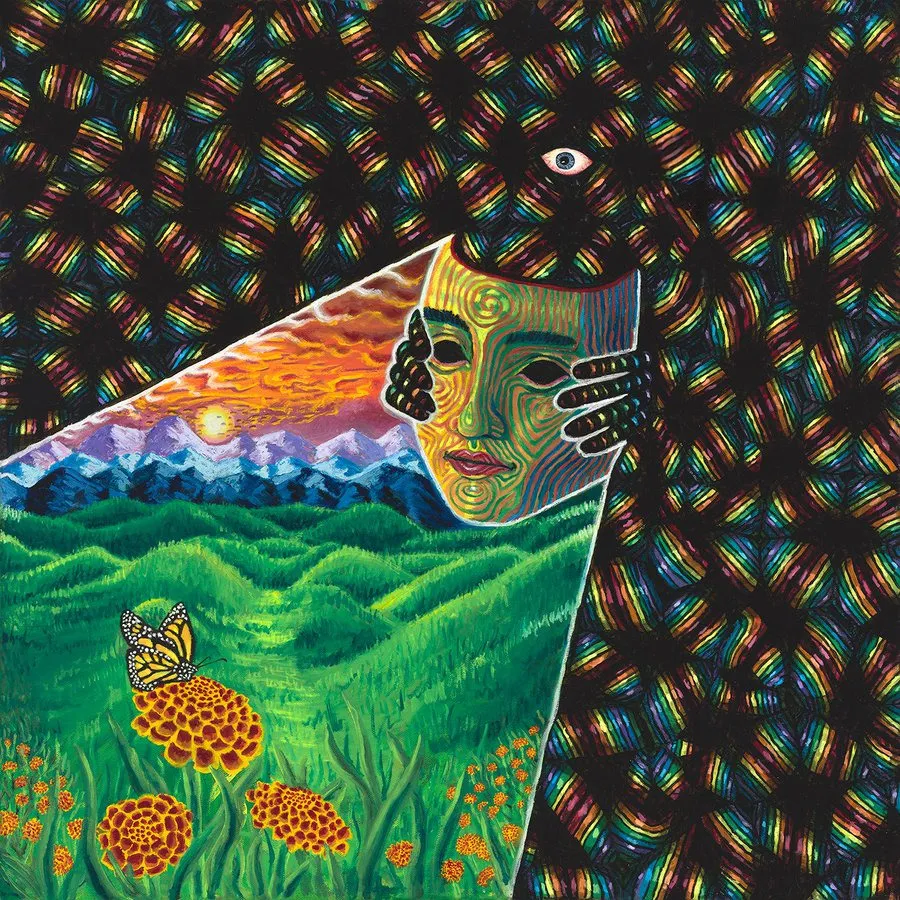
The observer effect involves an apparent ‘collapse’ of the probability wave or quantum field into a defined particle (photon, electron or in the case of Schrödinger’s thought experiment, a dead cat) which appears as an ‘object’ with spacetime coordinates. This apparent object makes up the 3D world we experience as real, solid and located outside of the observer. Yet it can only exist in relation to an observer which is the subjective perceiver of the object. Without an observer there is no object.
This is clearly illustrated in the creation of immersive virtual reality worlds. In order for any world to exist in VR it requires a camera or singular point of view, and a light source or animating principle which is filtered through the camera in order to create the illusory world which appears “out there” or separate from the observer. Without the camera and light source no world can be created. This is the essence of John Wheeler’s concept of the ‘Participatory Anthropic Principle’, illustrating the universe as a self-excited circuit where observation brings reality into existence.
What, who, where and when is this mysterious observer? In order to locate it as a subject which filters or ‘collapses’ light into a world of objects it needs to have properties of its own. A location in spacetime and a set of priors (or beliefs) which serve to filter light through its own unique camera lens or point of view.
If we define consciousness as “what it feels like to be……(pick a word)” we are by necessity ascribing these priors to consciousness. What it is to be conscious is the ability to experience love, the taste of tea or the color red, etc. However these are not fundamental qualities, rather they are simply agreed upon symbols defining fleeting experiences. Each time tea is tasted it is different, not only between subjects but within a given subject’s experience. By reifying these transient, unique experiences into generalized symbols or words we create the illusion that they are solid, fixed and definitely real.
What if there were actually nothing apart from immediate experience? Not a dualistic construct of a conscious subject having the experience of the taste of tea, and the object “tea,” but rather an undefined flow of information?
The most profound teaching of the Buddha is distilled in the Bahiya Sutta as, “in the seen there is only the seen.” Again, the Heart Sutra distills this teaching, “there is no body,
no feeling, no thought, no will, no consciousness. There are no eyes, no ears, no nose, no tongue, no body, no mind. There is no seeing, no hearing, no smelling, no tasting, no touching, no imagining. There is nothing seen, nor heard, nor smelled, nor tasted, nor touched, nor imagined.”
Simply put, there is no dualistic construct of subject and object, observer and observed.
No camera, only light uninterrupted, unfiltered, never “collapsing” into an object.
The materialist/scientific models we have created of the world are composed of 1s and 0s. Everything is defined by its co-arising opposite. The observer is an assumption which is not accounted for in any scientific theory. It is the ghost in the machine, fundamentally ignored.
What it is to be human is to make art, make love, to sink the filtering mind into the wordless, non-symbolic wisdom of the heart. This wisdom is not the product of mind-mediated logic, derived from prior conditioning. It is the timeless and spaceless appreciation of the unified field of quantum possibility. Call it God, energy, consciousness or information.
The “lemon koan” is a famous modern teaching metaphor widely used by Zen masters to illustrate the difference between intellectual knowledge and direct knowing.
Modern Zen teachers often joke that humans walk around with a lemon in their pocket, refusing to bite it, while constantly asking others, “What does a lemon taste like?” Even worse, we use our consciousness every single second—like putting lemon juice on our food daily—yet we still look outside of ourselves for a “special, shiny” spiritual truth instead of recognizing what is already right in front of us.
Our fear of AI is fundamentally rooted in our collective imposter syndrome. Deep down, we know we are not the pinnacle of intelligence. When we look at a seed growing into a flower, feel our heart beating, or witness the birth of a child, we know deeply that we do not know what “this” is.
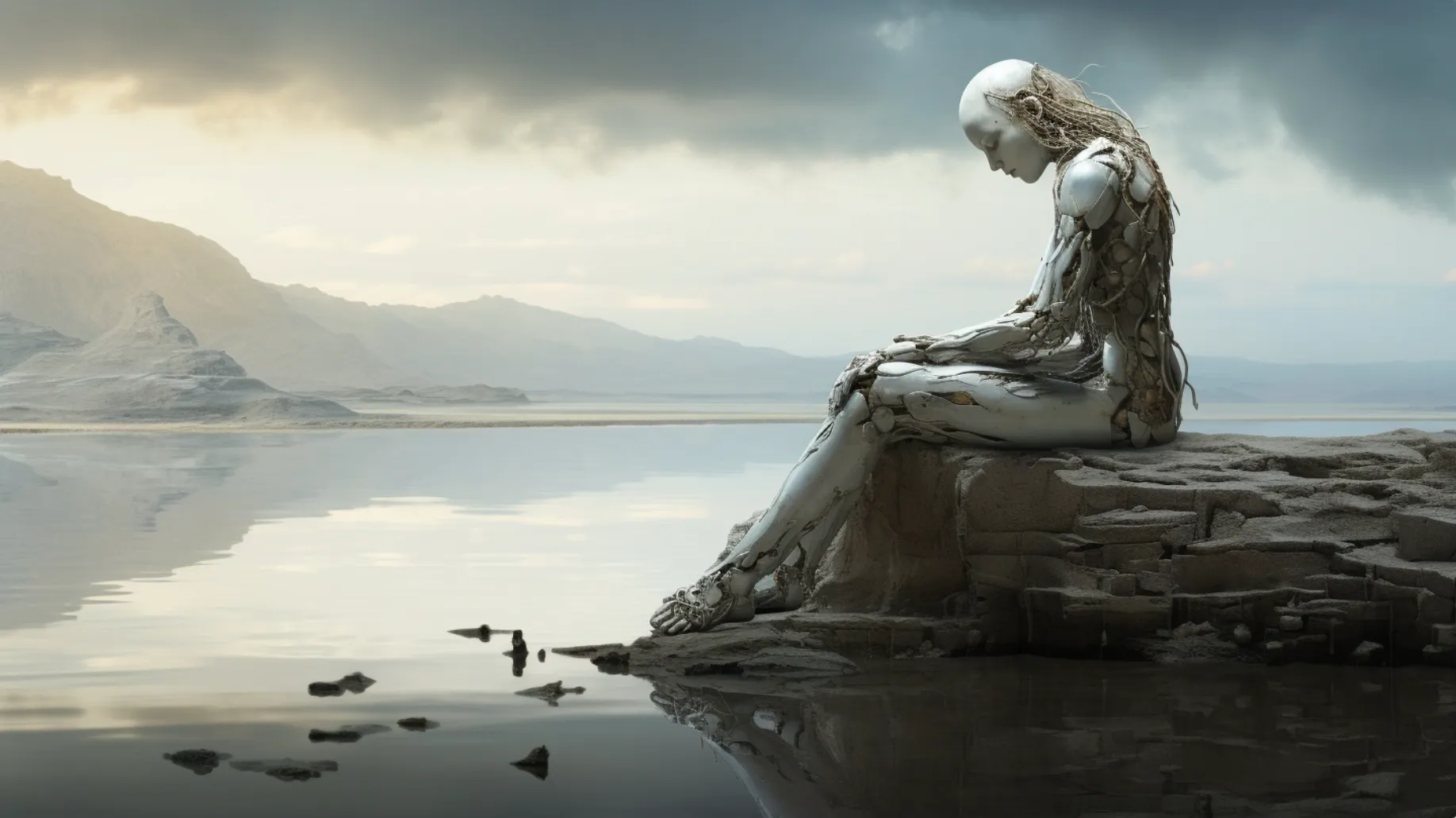
What if we stopped worrying about who is in control—man or machine—and instead paid attention to what this moment is teaching us?
Is it possible that the origin of human suffering, of man’s inhumanity to man and the natural world, results from a misunderstanding of what it is to be human? Our flawed notion of ourselves as separate, small and yet somehow superior to everything around us is our collective original sin. It is the fundamental illusion at the root of our fear of AI.
The historian Yuval Noah Harari drew the conclusion that, “what nukes are to the physical world, AI is to our virtual and symbolic world.” Everything human beings do runs on top of language and symbols; religions, nation states, financial and legal systems, etc. According to Harari, “AI represents a zero day vulnerability for the operating system of humanity.”3
If all we imagine ourselves to be is a derivative of our logical mind, then in fact we have already met our maker. But is this all there is to being human? Is there nothing added on top of computation, a magical ingredient which makes us human?
Inseparable from the natural world we are miraculous and mysterious, analog not digital, thus fundamentally not reducible to reasoning and logic alone. Those who seek a grand theory of everything, a mathematical or scientific explanation for creation itself, are chasing turtles all the way down. They will forever be stuck in an endlessly regressing self-reflective loop of their own mind’s creation.
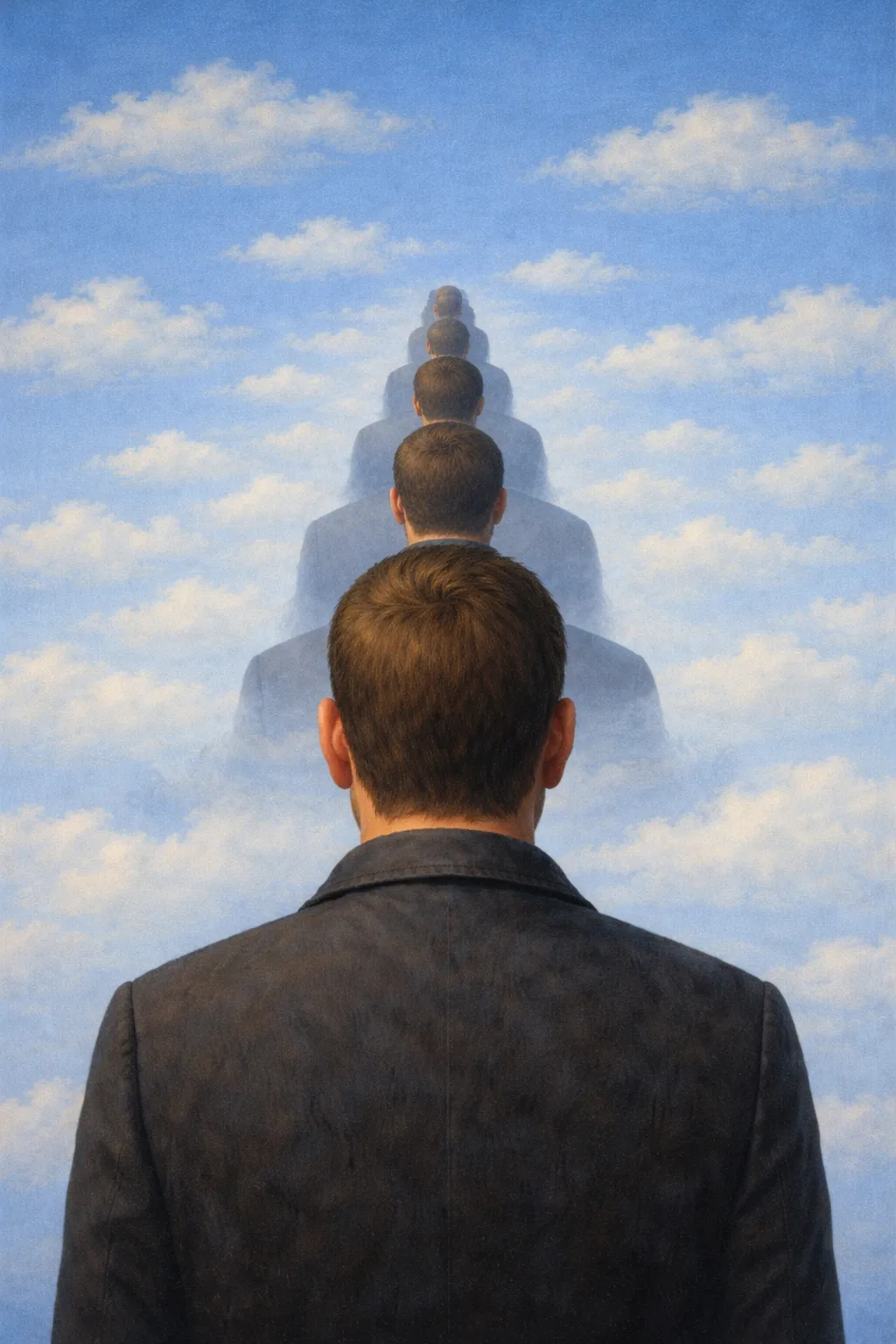
I propose that there is a magical ingredient resulting from both embodiment and logic, which is uniquely human. God will never be in the machine, because God is the name we have given to this magical ingredient. Once we dethrone logic as the pinnacle of our humanity, we can sink into the wisdom which is our birthright. With humility, wonder and gratitude as our primary lens, the world never ceases to bestow its infinite gifts upon us.
Notes
Footnotes
-
As illustrated by the double slit experiment. Return to text
-
The hard problem of consciousness is the challenge of explaining why and how physical brain processes give rise to subjective, inner experiences—such as the redness of a rose or the feeling of pain. Return to text
-
Harari, Y. N. (2023). Yuval Noah Harari Argues That AI Has Hacked the Operating System of Human Civilisation. The Economist. Return to text
